Compound library
Mechanism maps
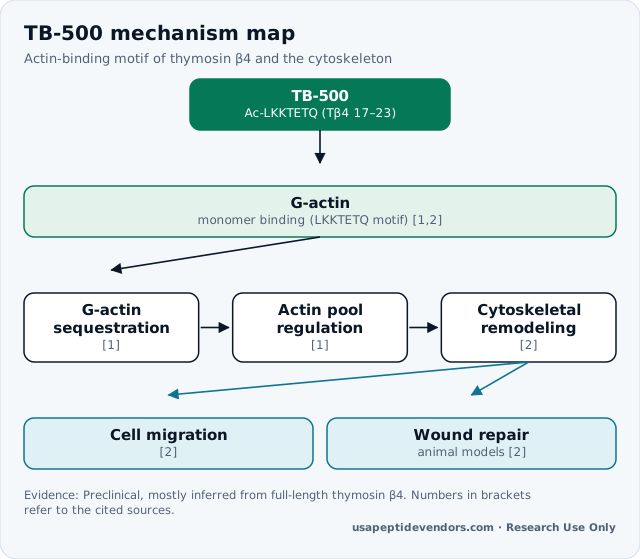
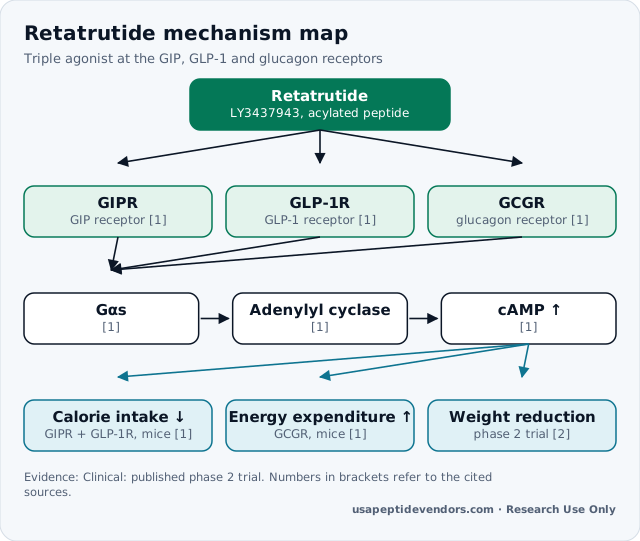
One-page diagrams of how each compound on the desk is thought to act: the receptor or target it engages, the signaling it triggers, and the downstream effects reported in the literature. Each map is drawn in-house from the papers cited under it and carries an evidence label, so you can see how established a mechanism actually is.
How to read a map
- Green boxes are the receptor or target. The heading says so when no receptor has been confirmed.
- White boxes are signaling steps, read left to right.
- Blue boxes are effects reported in the cited studies, with the model type (cell culture, animal, clinical) underneath.
- Bracketed numbers point to the numbered source list below each diagram.
BPC-157
Tissue research peptides · Evidence: Preclinical: cell culture and animal models
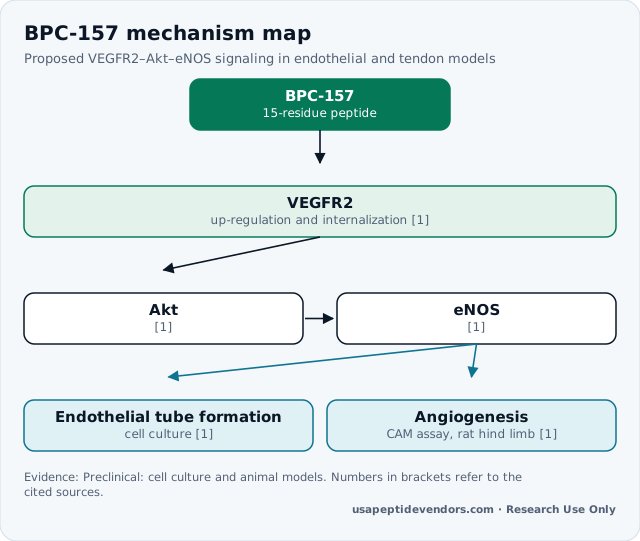
- Hsieh MJ et al. Therapeutic potential of pro-angiogenic BPC157 is associated with VEGFR2 activation and up-regulation. J Mol Med. 2017;95:323–333.
- Chang CH et al. The promoting effect of pentadecapeptide BPC 157 on tendon healing involves tendon outgrowth, cell survival, and cell migration. J Appl Physiol. 2011;110:774–780.
- Chang CH et al. Pentadecapeptide BPC 157 enhances the growth hormone receptor expression in tendon fibroblasts. Molecules. 2014;19:19066–19077.
TB-500
Tissue research peptides · Evidence: Preclinical, mostly inferred from full-length thymosin β4
Retatrutide
Metabolic research peptides · Evidence: Clinical: published phase 2 trial
CJC-1295
GHRH research peptides · Evidence: Clinical pharmacology study and rat studies
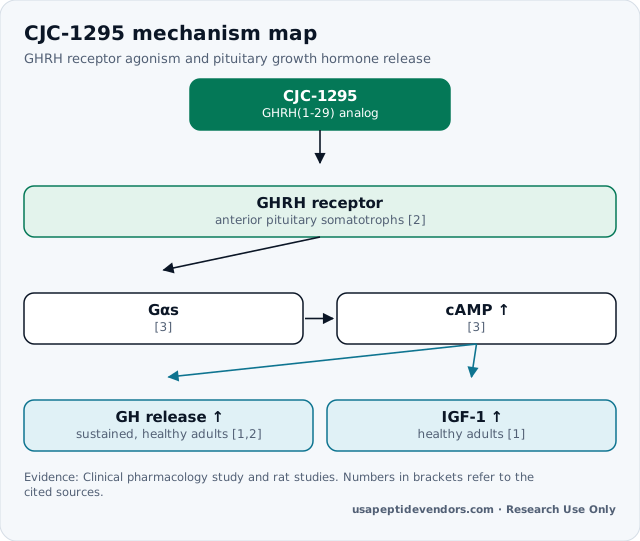
- Teichman SL et al. Prolonged stimulation of growth hormone (GH) and insulin-like growth factor I secretion by CJC-1295, a long-acting analog of GH-releasing hormone, in healthy adults. J Clin Endocrinol Metab. 2006;91:799–805.
- Jetté L et al. Human growth hormone-releasing factor (hGRF)1-29-albumin bioconjugates activate the GRF receptor on the anterior pituitary in rats. Endocrinology. 2005;146:3052–3058.
- Cunha SR, Mayo KE. Ghrelin and growth hormone (GH) secretagogues potentiate GH-releasing hormone (GHRH)-induced cyclic adenosine 3′,5′-monophosphate production. Endocrinology. 2002;143:4570–4582.
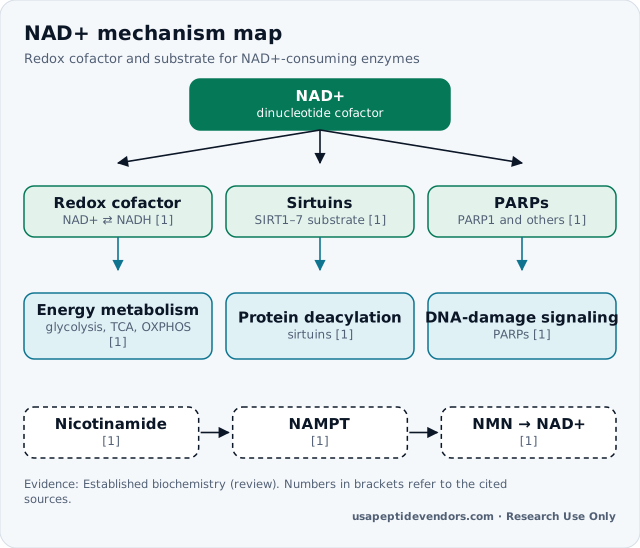
NAD+
Cofactor research materials · Evidence: Established biochemistry (review)
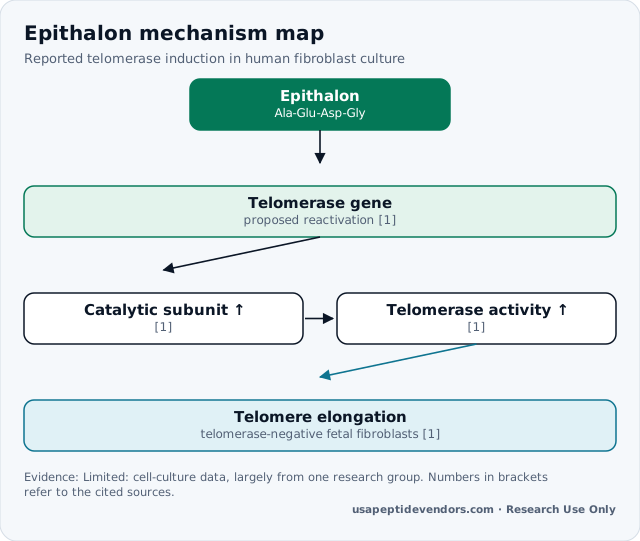
Epithalon
Tetrapeptide research materials · Evidence: Limited: cell-culture data, largely from one research group
FAQ
Where do the mechanism maps come from?
Each map is drawn by the UPV desk from the cited papers listed under it. Every box carries bracketed numbers pointing to the source that supports it, and we leave out links that the sources do not show.
Do the arrows mean a compound has proven effects in people?
No. Arrows show the signaling reported in the cited studies, which are often cell or animal models. Each map states its evidence level, and none of it is medical advice.
Can I reuse a diagram?
The diagrams are original works of USA Peptide Vendors. Contact the desk for licensing; please link back to the compound page when citing.