Tissue research peptides
BPC-157
BPC-157 is one of the most searched research peptides in US vendor catalogs. UPV pages focus on lot documentation habits, not medical claims.

Original illustration by USA Peptide Vendors. Artistic, not a structural model.
Chemistry facts
- G1
- E2
- P3
- P4
- P5
- G6
- K7
- P8
- A9
- D10
- D11
- A12
- G13
- L14
- V15
- CAS number
- 137525-51-0
- Molecular formula
- C62H98N16O22
- Molecular weight
- 1419.5 g/mol
- PubChem CID
- 9941957
Verified 2026-11-09 against PubChem CID 9941957. Values we could not verify are left out.
How BPC-157 is thought to work
Evidence level: Preclinical: cell culture and animal models. See every diagram in the mechanism map library.
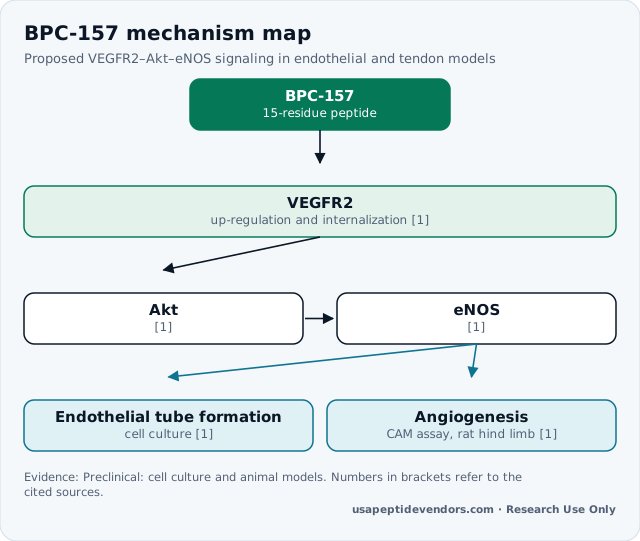
- Hsieh MJ et al. Therapeutic potential of pro-angiogenic BPC157 is associated with VEGFR2 activation and up-regulation. J Mol Med. 2017;95:323–333.
- Chang CH et al. The promoting effect of pentadecapeptide BPC 157 on tendon healing involves tendon outgrowth, cell survival, and cell migration. J Appl Physiol. 2011;110:774–780.
- Chang CH et al. Pentadecapeptide BPC 157 enhances the growth hormone receptor expression in tendon fibroblasts. Molecules. 2014;19:19066–19077.
Research context
Public literature discusses gastric-derived peptide fragments in preclinical models. USA Peptide Vendors does not interpret clinical outcomes; we map which vendors publish assay paperwork for labeled BPC-157 SKUs.
Buyer notes
- Prefer lots with both purity % and measured content (mg) on the certificate
- Confirm vial label lot string matches the PDF
- Ask whether sterility/endotoxin panels exist if your protocol requires them
Related USA vendors
US catalog with lot notes that usually sit next to the buy button
Northbound Research — OpenFile clearBatch IDs near titles; Midwest shipping language
Cedar Analytical — OpenFile clearSmaller catalog, stronger paperwork habit
Pine Ridge Peptides — OpenFile conditionalStaple SKUs, lighter long-tail files
FAQ
What should a BPC-157 COA include?
At minimum: analyte identity, lot/batch ID, purity method (often HPLC), date, and lab name. Content assays (measured mg vs labeled mg) are a strong transparency signal.
Is BPC-157 approved for human use?
No. Materials discussed here are Research Use Only and not for human consumption.
← All compounds · Mechanism maps · BPC-157 vendor guide · All desk notes